
This is a market update prepared by John Wallace of Sentinel Portfolio Management Limited titled ‘Déjà vu all over again’, following recent global events.
Every day in March had the same news story. President Trump would reassure the world that the war in Iran would soon be over and then caveat that statement, more often than not immediately, with the threat that actually the worst could be yet to come. Finally, POTUS would conclude the update by listing his Iranian targets with indifference that their destruction would constitute a breach of the Geneva Convention.
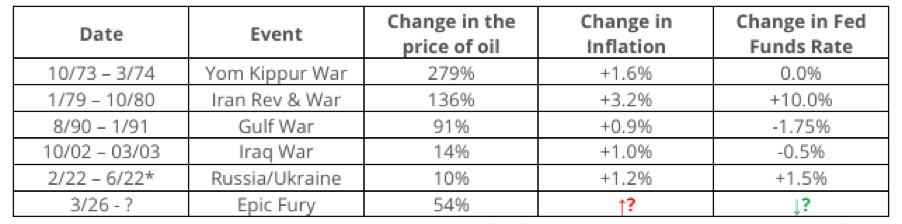
Every time tensions rise, the market reaction has followed a familiar playbook – a stronger dollar, weaker equities and despite a general rise in risk aversion, higher bond yields as markets price in the inflationary consequences of elevated energy prices and further disruption to supply. The below table provides evidence of previous Middle East conflicts and the corresponding increase in the Oil price and inflation.
Source: Redwheel
Trump has found that not every party to a negotiation will agree to a deal that could be seen as fair, mutually beneficial or at least pragmatic. Unlike New York property deals or tariff deals which terrified European politicians, the Iranian regime does not value wealth for the rulers or population, nor the safety of their people nor seeing their standards of living improve. Iran is not concerned that western journalists rank it 176 out of 180 in the Human Freedom Index or 151 out of 181 in the Transparency International’s corruption index. The theocratic regime only wants to guarantee its own survival and further its goal of “death to Israel and America”. The Iranian regime enjoys a far longer time horizon than Trump who faces the midterms in November.
Just as Trump has discovered that parties to a deal do not always behave in a textbook fashion, nor does economic cause and effect repeat consistently. Now the price of oil, gas, fertiliser (and soon food) has spiked, central banks are now widely expected to hold off cutting interest rates and in fact are considering raising them. Modern economic wisdom states that you should raise interest rates to combat higher inflation. A higher central bank rate increases market lending rates and therefore the cost of borrowing money. The higher cost lowers demand with businesses and individuals less likely to borrow. Workers, despite feeling their real disposable income squeezed, will be less likely to ask for and receive a pay rise if the economy, and/or their employer, is struggling. If wage rises and prices do not produce a feedback loop inflation is defeated. A second benefit to higher rates is the inflation rate of the average price of a basket of goods; if you slow the economy, thus reduce overall demand, some goods and services may fall in value, offsetting the higher price of energy and pushing inflation toward the lesser spotted 2% target.
This maybe be prudent policy in a strong economy where business creation is strong, profit margins high and job opportunities plentiful, however that is not the reality currently faced. Unemployment in the UK and US has been rising steadily since the lows in 2023. The US numbers are particularly notable given it has had zero immigration for many months. Raising central bank rates now may well help economies hit the 2% inflation target but at the expense of causing a recession. Adding higher borrowing costs to higher energy costs will cause a proportion of businesses to fail, however killing businesses to decrease demand for energy intrinsically feels like the wrong way to deal with the problem. Should this policy be implemented and higher inflation is coupled with higher interest rates and lower job opportunities the government may well need to rebrand the cost-of-living crisis soundbite to a cost-of-living disaster. There is every chance inflation will already be temporary due to the demand destruction caused by the high price of energy.
Inflation targeting monetary policy maybe reaching the end of its useful life just as money supply targeting previously became outdated. Money supply targeting failed when the velocity of money (how quickly money changes hands) became a variable having previously been a constant in the equation. Inflation targeting may now be less useful to the economy in the new economic paradigm. High levels of public debt, high deficits and a total dependence on imported goods to facilitate a service lead economy. We remain alert to central bank policy error.
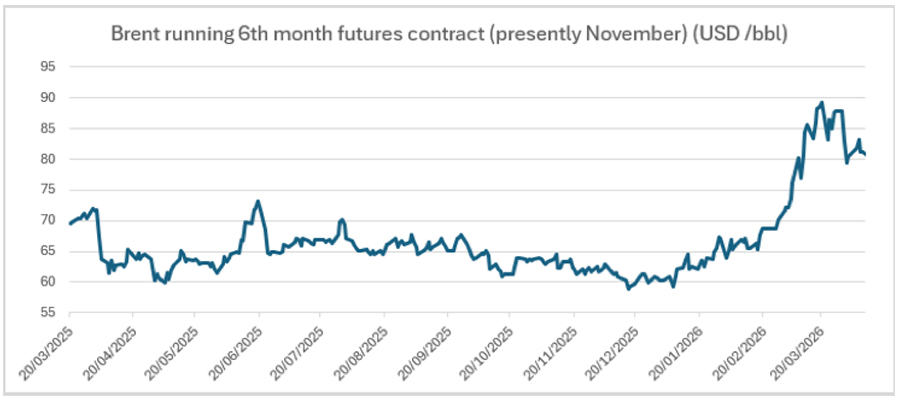
It may well be that central banks hoping that the June oil future contract showing below, which is significantly below the current oil price, is correct. It is showing that the market expects an easing of supply pressures over the next couple of months, although with the attacks on Saudi energy facilities cutting production capacity by about 600,000 barrels per day (bpd) and throughput on its East West pipeline by about 700,000bpd, we are doubtful. We expect oil to settle at a higher price than seen over the last few years, pushing up the global rate of inflation.
Source: Macrostrategy
Market uncertainty does create opportunity and the Sentinel funds have all taken advantage of pricing anomalies since the end of February. Interestingly, each Trump threat followed by TACO (Trump always chickens out) is met with less market volatility than the previous iteration and we are hoping this remains the case, although are prepared for the situation to escalate.
Past performance is no guarantee of future returns. The value of investments may fall as well as risk and is not guaranteed.
Please note that this has been prepared for information purposes only and does not constitute advice or guarantee investment returns.

